
HomeProblemSolutionProductAI teamMarketCompetitionModelGo-to-marketTractionTeamStatusThe askData room
For investors · pre-seed 2026 · raising £750k

One system to run the whole business. An AI team built in.

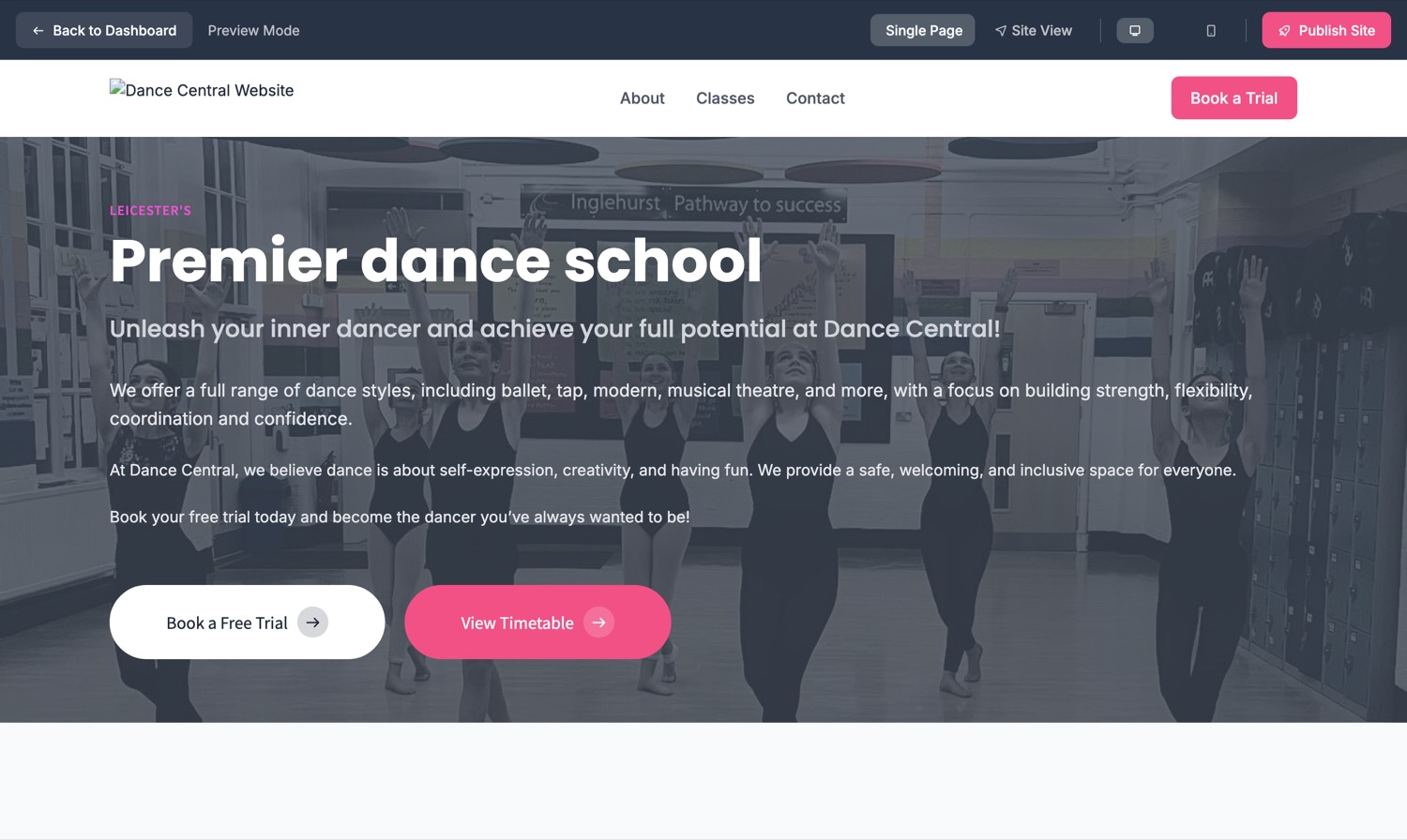
Website, bookings, customers and money on one record, for studios and service businesses.

  • Everything in one place: website, bookings, customers, email and payments
  • Nothing to connect: not an AI layer on Google, HubSpot and Xero. Simma is the tools
  • An AI team inside: six AI teammates and a chief of staff, working with your approval
Livesince 3 Sept
£0revenue, pre-launch
2design partners
The problem

Business software
doesn't join up. People do.

Why nowAI can only work on what it can see. 54% of UK small and medium businesses now use AI; 80% of IT leaders say data integration is the biggest obstacle to it.
The problem, in full →

In a one-person business, it's the owner at 10pm; in bigger companies, whole teams. We start where it hurts most per person.

11 hrsa week on admin (UK owners)
8 loginseven with an all-in-one
29%of a large firm's 897 apps are connected
Customer data Bookings Calendar Payments Invoices Accounts Documents Team Spreadsheet Email ChatGPT Website ? ? ? 22:14

Amex / Small Business Saturday UK SME Barometer 2026 · Simma's own count of a typical instructor's tools, September 2026 · MuleSoft Connectivity Benchmark 2025 · British Chambers of Commerce, March 2026.

The solution

Simma doesn't join the tools up. It is the tools, and the foundation for the agents.

Why now, answeredAI with the context, and a platform to act in. The owner asks "who hasn't booked since the summer?" Sage finds them, Maya drafts the note, the owner says yes. One question, instead of five steps and an evening.
The solution, in full →

Website, bookings, payments, customers, email, brand, documents, team and Google, built as one system on one record. Simma started as an all-in-one, before the AI wave: the platform came first, and the AI team is built on it. Draft is a feature. Finish is a platform.

1 logininstead of eight
0 connectorsbetween its own tools
1 recordevery customer, booking and payment
Customer data Bookings Calendar Payments Invoices Accounts Documents Team Reports Email AI team Website One record
The product

Every tool a business runs on. Built as one.

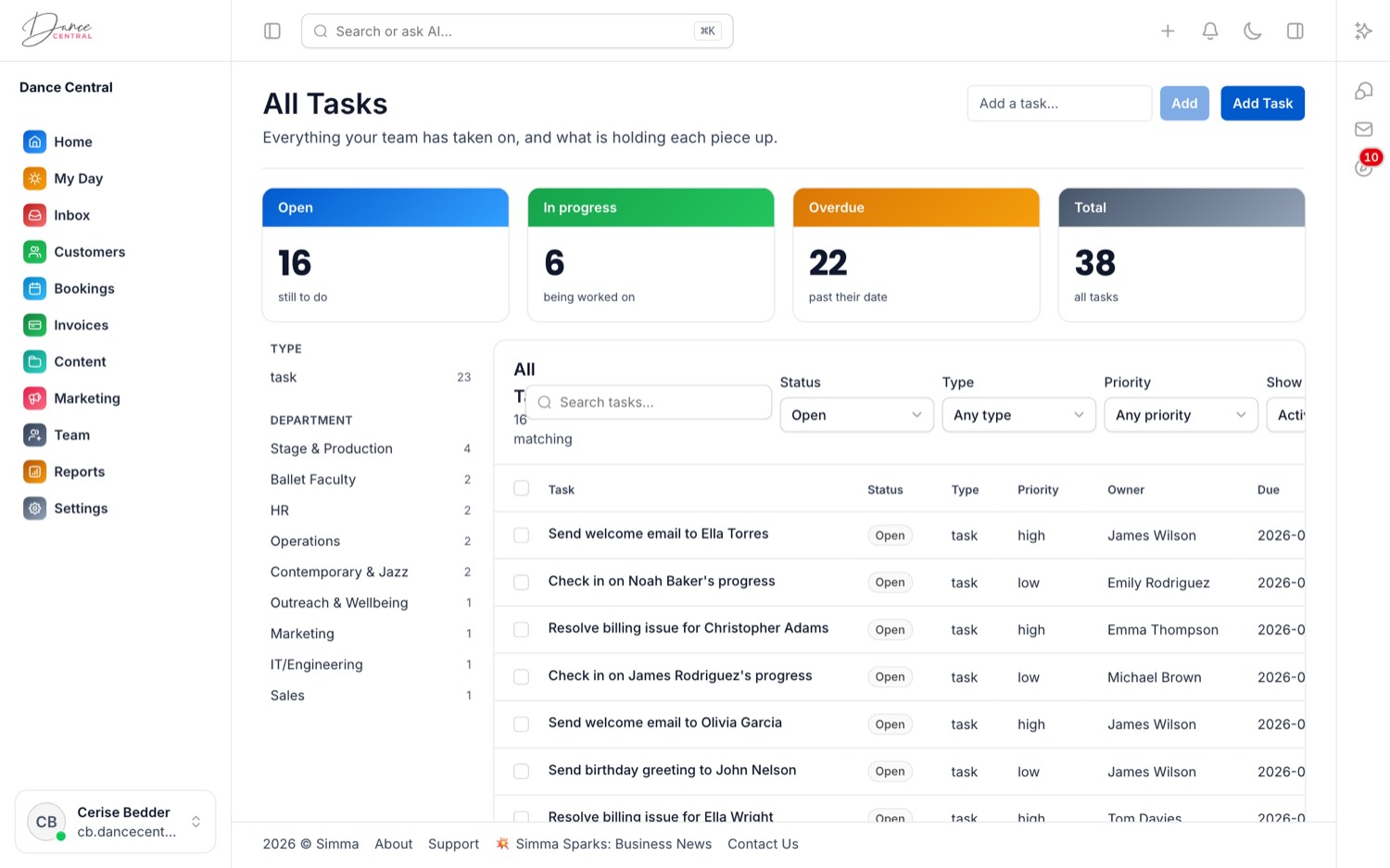
The CRM, the booking system, the online shop and the website aren't four products joined together. In Simma they're one system, and so are the files, the rota and the invoices. Everything is filed once, on one record, whether the business sells its time, its products or both. Change something once, and every part of the business knows.

13 toolsa business would otherwise buy separately
1 recordevery customer, booking, order and file
6 lensesone inbox, one calendar, the numbers
Your AI teamAnd an AI team works in every one of them.Maya on marketing, Sam on sales, Charlie on customers, Molly on the money, Oli on operations, Peter on what to sell and at what price, and Sage, the chief of staff, across them all. The owner says yes before anything goes out.
MSCMOPSHover or tap a face
Meet the AI team →
Different businesses

One system. Different businesses.

A dance studio, a bike shop, a café and a plumber look nothing alike. Underneath, they run on the same record. Pick one and follow its Tuesday.

Tuesday at a dance studio

Simma fills the classes and runs the studio.

The owner teaches and makes the decisions. Simma does more of the running.

Sells classes, trials, class packs and memberships.

  1. BuiltJamie books a trial class on the studio's website and pays the deposit.
  2. BuiltThe booking, the payment and Jamie's details land on one customer record.
  3. NextMaya sees Thursday's 7pm has five spaces and drafts a post and a note to lapsed students. The owner approves it between classes.
  4. BuiltA parent renews the family's class pack from the customer portal.
  5. NextSam follows up yesterday's enquiry about the children's class, while it's still warm.
  6. BuiltThe evening's class lists show who's coming, and who has paid.
  7. NextSage: “Tomorrow is full except the 10am. One invoice is overdue.”
Tuesday at a bike shop

Simma sells the bikes and keeps the workshop full.

Bikes and parts sell online and in the shop; the workshop runs on bookings and jobs. All of it on one record.

Sells bikes, parts and workshop time.

  1. BuiltAlex books his bike in for a service on the shop's website.
  2. BuiltThe job lands on Alex's record, next to the bike he bought here last spring.
  3. NextOli fits it into Thursday's workshop day, around two repairs already booked.
  4. BuiltA helmet sells online, and the stock count drops for the shop floor too.
  5. BuiltA mechanic adds a new chain to Alex's job, with the time it took.
  6. NextMaya sees next week's workshop is half empty and drafts a note to customers due a service.
  7. BuiltAlex collects his bike and pays at the till. It all goes on his record.
  8. NextSage: “Workshop full until Thursday. Three online orders to pack.”
Tuesday at a café

Simma brings people in and keeps service moving.

The till, the tables, the online orders and the rota share one record, so the quiet hours and the gaps show up.

Sells food and drink, tables and private events.

  1. BuiltThe first click-and-collect orders are already on the kitchen screen.
  2. BuiltA table for six is booked on the website for Saturday brunch.
  3. NextMaya sees Tuesday afternoons are quiet and drafts an offer for regulars.
  4. BuiltEvery sale at the till lands on the same record as the bookings and the online orders.
  5. NextSam answers an enquiry about a private party, with the events menu attached.
  6. NextOli flags that Saturday's rota is one person short.
  7. NextSage: “Saturday is 80% booked. One shift still to cover.”
Tuesday at a plumber

Simma turns enquiries into finished, paid jobs.

The plumber does the plumbing. The quotes, the diary, the invoices and the chasing happen around them.

Sells jobs, call-outs and materials.

  1. BuiltA leaking-boiler enquiry comes in through the website.
  2. NextSam drafts a quote from the rate card. The plumber checks it and sends it.
  3. BuiltThe customer accepts the quote online, and it becomes a job.
  4. NextOli fits the job into Thursday, between two others nearby.
  5. BuiltYesterday's job is closed with its time and materials, and the invoice goes out.
  6. NextMolly spots an invoice 14 days overdue and has a reminder ready.
  7. NextSage: “Three jobs tomorrow. One quote has waited over a week.”

Built: in the product today. Next: the AI team. Its roles, limits and approvals are designed and the engine it runs on is live; the named teammates are the next build. See Status.

Different businesses. The same record underneath.

Eight businesses, side by side →
Not just us

Where the people building AI see it going.

“The notion that business applications exist, that’s probably where they’ll all collapse, right, in the agent era… The business logic is all going to these agents.”
Satya Nadella, CEO, MicrosoftBG2 podcast, December 2024
“AI has stopped being a feature and started being the foundation.”
Y CombinatorRequests for Startups, Summer 2026
“The context problem becomes much more acute… It’s often fragmented across legacy systems or environments that don’t play nice with agents.”
Aaron Levie, CEO, Boxon X, June 2026
“You can take ten SaaS point solutions and bundle them into a single suite… Not a chatbot bolted onto a 2010 UI.”
Jared Friedman, Y Combinator“SaaS Challengers”, Summer 2026
“The art of providing all the context for the task to be plausibly solvable by the LLM.”
Tobi Lütke, CEO, Shopifyon “context engineering”, June 2025
“Building this today requires brutal integration work… There’s no product that connects all this context into a single intelligence layer.”
Diana Hu, Y Combinator“The AI Operating System for Companies”, Summer 2026
“Context engineering is the delicate art and science of filling the context window with just the right information for the next step.”
Andrej Karpathyon X, June 2025

These are quotes about the market, not about Simma. Simma is not affiliated with Y Combinator, Microsoft, Box, Shopify or anyone quoted here. Each quote links to its source.

The market

Every business, eventually. Solo and micro first.

30.5m UK and US businesses with fewer than 250 staff could run on Simma. We start with instructors: 15,560 registered UK studios and instructor businesses, and 413k education and sport businesses with up to nine staff. Then Simma climbs, one size at a time, and one country at a time.

£382bnTAM · every business in the world
£100bnSAM · UK and US, under 250 staff
£169mSOM · 50,000 customers × ~£3,380 a year
Solo£1.5k a year each
Year 1
Micro£5.4k a year each
Year 1
Small£10k a year each
Year 3
Medium£42k a year each
Years 4–5
Enterprise£161k a year each
Year 5 on
Competition

The record, or the work. Simma is built to own both.

Software suites own the business's records. AI agent platforms do the work, across other companies' tools. Simma is the system of record with the AI team built on it, and meets a business as it starts, before it has a stack to switch from.

Specialists

Wix, HubSpot, Fresha, Mindbody

Deep on one job, or one kind of business. The owner joins them together, and the customer record is split between them.

Business suites

Odoo, Zoho

Apps on one record, now with AI agents. A toolkit the owner or a partner configures; Simma is set up for the type of business from the first day.

AI workers

Viktor, Lindy, Sintra

Do real work across other companies' tools. The record, the history and the rules stay in those tools.

The honest counterpoint: incumbents have distribution and speed, and the suites' AI agents are live before Simma's. The bet is that AI needs one record to act on, set up for the business from day one, and the record is the platform.

The competition, in full →

How we make money

Free to start. Priced to grow with the business.

The cheapest way to start: on Free there is no monthly bill until the business is paid. For a business taking its first few hundred pounds a month, that costs less than a website, booking tool, email tool and card processor bought separately. As it grows, it pays for the whole system: one record, the AI team, nothing to join up.

Subscription · per business, per month
Free£01 user
Lite£592 users · inc. VAT
Starter£1195 users · inc. VAT
Business£19910 users · + VAT
Pro£29925 users · + VAT
Scale£49950 users · + VAT

Every plan includes the website, bookings, CRM, payments and the AI team. Paid plans add users, customers and AI-team capacity. Extra users £5/month. Franchise pricing is custom. UK prices: Free, Lite and Starter include VAT, because most of their buyers are sole traders who can't reclaim it; Business, Pro and Scale are plus VAT, which VAT-registered businesses reclaim.

Simma Pay · on every payment

5%+ 50p

2.5%+ 25p on Scale

Simma earns when the business gets paid. Paid plans lower the rate: 4% + 40p on Lite and Starter, 3.5% + 35p on Business, 2.5% + 25p on Pro and Scale.

The model and the five-year numbers →

Go-to-market

Land with the website. Expand into the whole business.

Many instructors have a website they can't easily change. Simma gives them one they can run, with the timetable and booking built in; bookings, payments, customers and the AI team follow on the same record. Paid selling starts in month three.

15,560UK studios to start with
250paying customers by month twelve
2,000by the end of year two
The Simma marketing machine · half product, half marketing
  1. Get foundSimma Sparks content, search and AI answers
  2. Land themA website they can run, on the free plan
  3. Follow up, every timeMaya and Sam, on every enquiry and trial
  4. Let them bring the next"Made with Simma" on every site and receipt
  5. Measure, then spendCost to win and retention, by channel
Traction

Pre-launch, on purpose. The first businesses are lined up.

Pre-revenue. Paid onboarding starts when the founder goes full-time at the first close. No business is named until it agrees to be.

2design partners: a UK dance school and a UK media business
2more businesses starting at launch (verbal)
1multi-brand franchise group in early talks
0paying customers yet
What we'll show by month six
  • Both design partners live on SimmaWebsites and bookings running on the platform
  • Written commitmentsA price and a start date
  • A named launch listStudios and instructors waiting to join
  • Recorded conversationsWhat instructors pay for today, and why
  • The first paying studiosFrom month three, through Simma Pay
  • A franchise pilot decisionYes or no, with the reasons

Each box gets a date when it's done.

The team

"I'm building the platform I always wanted."

The platform is in production. No customers yet — and the honest reason is me: I still lead product at a FTSE 100 company by day, and I won't take on businesses I can't yet serve. Simma needs me full-time to win its first customers; its first customers are what get me full-time. That chicken-and-egg is what this raise is for. I go full-time from first close.

Built it twiceDatlyn, for the media business I co-founded with my father; then one events platform for 2,000+ sites
2× revenueas Managing Director of that media business, at 40 people
2 soldbusinesses: Workwear City, a 22,000+ product online store; and iStudio Publisher, to its developers for a 50% revenue share
Full-time from first close

The raise pays for me full-time and three hires, at junior level:

  • Month 2Sales and customer success
  • Month 4An engineer
  • Month 6A second sales and customer success hire

Beyond them, a bench of eight senior people I've worked with for years, who have asked to join as Simma grows:

VTEngineeringPHSalesDICustomer successLOMarketingJGProductMSOperationsMSCreativeSTContent & media

The team, in full →

Status

What works today, and what doesn't yet.

A summary of the status page, which is measured against the code and production and dated. Every other page speaks in vision; this one doesn't.

The app, in productionsimma.ai, released 3 September
● Live
Website builder, editor and publishing
● Live
Simmi on the website, and the customer portal
● Live
Eight-layer cascade: features, menus, words, emails, currency
● Live
Taking payments onlineBuilt and tested; live keys at launch
◐ Built
Google Business Profile, phone, recurring invoices
◐ Building
Published customer websites (simmasite.com)Fixed in code, waiting on a DNS change
Defect
Simma Pay rates, as pricedBeing applied on every payment path
Defect
The AI teammates: Maya, Sam, Charlie, Molly, Oli, Peter, SageThe records, approvals and audit trail they need are live
○ Next
Paying customersPaid launch at the first close
○ 0

Every line, dated and measured →

The ask

£750k to make Simma full-time, launch it, and win its first customers.

A SeedLegals SeedFAST at a £4m pre-money cap: £250k under SEIS, then £500k under EIS. Eighteen months of runway; the seed raise starts at month 12, and a raise takes a few months.

The raise

£750kpre-seed · £4m cap

18months of runway
250paying customers by month twelve
Sagelive behind the approval gate

What I want from you: twenty minutes and a hard look — and your view on whether the first paying customer is two months away or six, once I'm full-time.